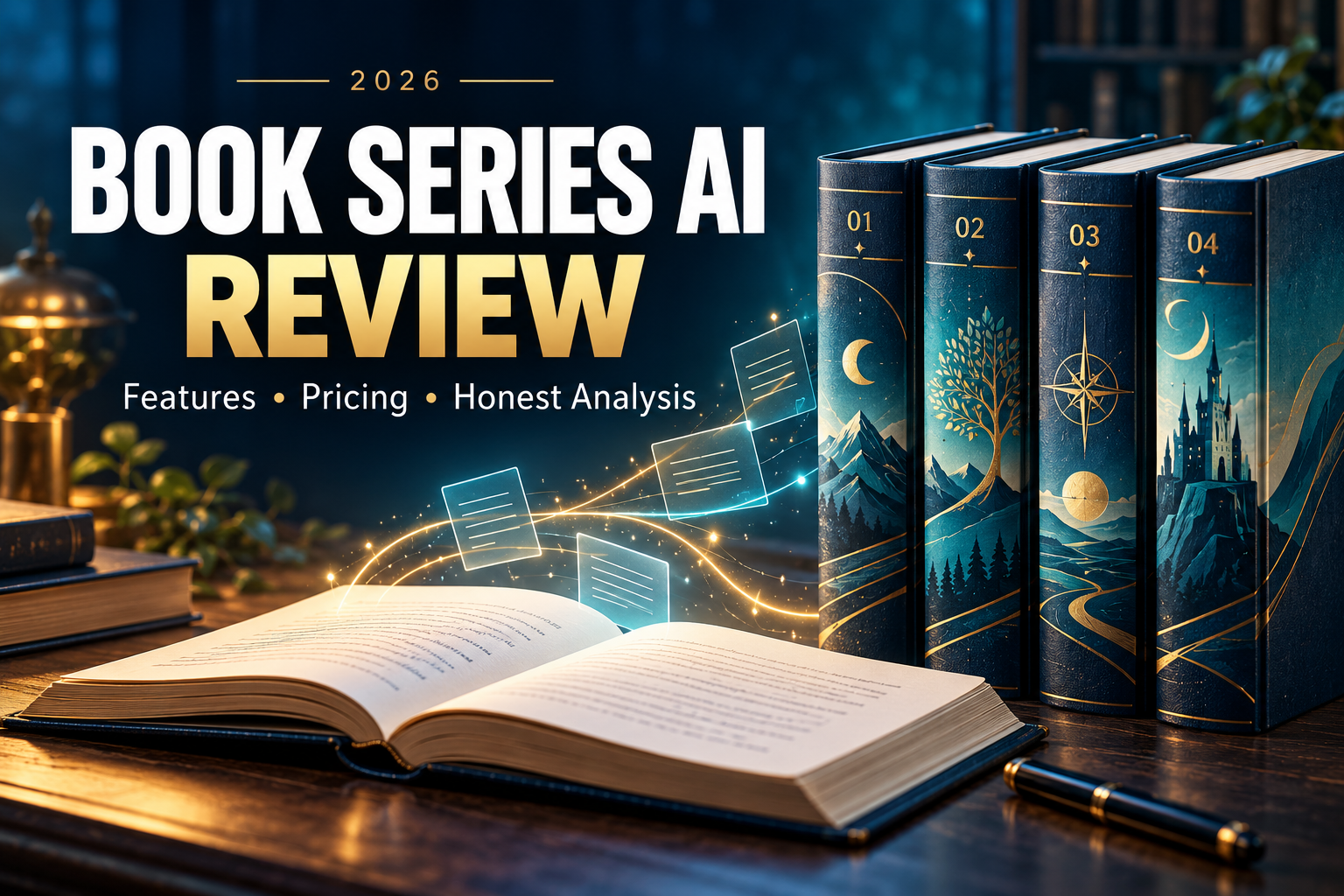

Creating one book is a project. Creating a connected series means coordinating characters, timelines, plots, covers, and reader expectations across several books.
That is the problem the Book Series AI aims to address.
According to the supplied product description, the platform takes a single concept and helps develop it into a connected series, with manuscripts, a Series Bible, matching covers, marketing copy, and KDP-oriented formatting.
The appeal is easy to understand: if readers enjoy your first book, related titles give them a reason to stay with you. But having six books available does not mean every reader will buy all six.
This Book Series AI review examines the described features, the publishing strategy behind them, the advertised launch price, and the limitations that matter before you buy.
Quick verdict: Book Series AI may suit publishers who want help organizing and producing a connected backlist. Its value depends on output quality, editing flexibility, usage limits, and the time it actually saves. The supplied material does not establish guaranteed royalties, error-free continuity, or verified seven-day results.
Review transparency: This is an analysis of the supplied product material, not a documented hands-on test. No account access, sample manuscripts, verified earnings reports, or seven-day testing records were provided.
Affiliate disclosure: If you purchase through an affiliate link added to this article, the publisher may earn a commission at no additional cost to you.
Interested in the series-first workflow? Review the Book Series AI offer and confirm the included features, usage limits, and checkout price before purchasing.
Book Series AI at a Glance
| Item | Details from the supplied material |
|---|---|
| Product | Book Series AI |
| Main purpose | Help create connected book series from one idea. |
| Described capabilities | Series planning, Series Bible, continuity support, manuscript generation, matching covers, titles, blurbs, keyword and category suggestions, KDP formatting |
| Intended content | Fiction and nonfiction series |
| Advertised launch price | Approximately $17 as a one-time payment |
| Additional offer | A separate publishing resource covering niches, schedules, keywords, and launch planning |
| Most relevant users | KDP publishers, authors, ghostwriters, and small publishing businesses |
| Main limitation | Manuscripts, metadata, and artwork still need human review. |
| Unconfirmed details | Current price, exact limits, export formats, license terms, upgrade costs, support, and refund policy |
| Earnings evidence | The supplied material does not substantiate typical user income. |
The price and capabilities above reflect the source description. They should not be treated as independently verified current product specifications.
What Is Book Series AI?
Book Series AI is described as an AI publishing platform built around connected series rather than unrelated standalone books.
A conventional writing workflow might begin with a prompt, produce one manuscript, and leave the author to manage everything else. For a series, that “everything else” becomes substantial.
You need to remember a character’s age, relationships, background, and motivation. You need to track what happened in earlier books, what remains unresolved, and how the next installment advances the larger story.
You also need the collection to look connected. Covers, titles, descriptions, and numbering should help readers understand where to begin and what to read next.
Book Series AI attempts to organize those pieces within one project. That coordination is the most interesting part of its proposition.
The relevant question is whether it helps create a coherent collection that readers want to continue and whether doing so requires less work than your existing process.
Why a Connected Series Can Be More Valuable Than Standalone Books
A standalone title can satisfy a reader and end the relationship there. A series gives that reader additional books to consider.
This can improve revenue per reader when later volumes deliver enough value to encourage continued reading. It also creates a backlist: a collection of published titles that remains available as you release new work.
A Simple Read-Through Example
Consider this hypothetical five-book series:
| Volume | Illustrative buyers |
|---|---|
| Book One | 100 |
| Book Two | 65 |
| Book Three | 45 |
| Book Four | 35 |
| Book Five | 28 |
| Total book purchases | 273 |
These numbers are an illustration, not Book Series AI customer results or a prediction.
The example shows how 100 initial buyers could generate 173 additional purchases across later volumes. It does not establish profit, since prices, royalties, editing expenses, promotion costs, and other factors remain unknown.
Read-through describes how effectively readers move from one volume to another. In this simplified example, 65 of the first 100 buyers purchase Book Two.
A connected catalog creates more opportunities to earn from the same audience. Strong read-through depends on the reading experience, not simply on the number of titles available.
How Does Book Series AI Work?
Based on the supplied description, the proposed workflow begins with one idea and develops the series around it.
A practical sequence would be:
- Define the concept, intended reader, and genre.
- Plan the wider series and each volume’s role.
- Establish recurring characters, settings, and continuity details.
- Generate individual manuscripts.
- Review and revise the manuscripts.
- Prepare coordinated covers and listing copy.
- Inspect the formatted files before submission.
- Publish suitable work and evaluate reader response.
This sequence combines the described automation with necessary editorial work. It is not a verified walkthrough of the interface.
The source does not establish the exact number of books you can generate, generation allowances, supported export formats, or the degree of control available after drafting. Those details matter when comparing the offer with your needs.
Book Series AI Features Explained
Series Planning Before Manuscript Generation
Planning the collection before writing can help each volume contribute to a larger purpose.
For fiction, that might include recurring characters, an overarching conflict, individual plots, character development, and unresolved threads. For nonfiction, it could mean mapping a beginner’s journey through progressively more advanced problems.
Imagine a cozy mystery series set in a seaside bakery. Each book could resolve a different mystery while gradually developing the baker’s relationships and personal history.
That creates a reason for each installment to exist. Simply dividing one oversized manuscript into six parts may leave readers with incomplete experiences.
A useful plan balances the satisfaction of the individual book with the appeal of the wider collection.
Series Bible and Continuity Support
The Series Bible is potentially one of the platform’s most useful features.
A series reference document can track:
- Character names, ages, appearances, and histories.
- Relationships, motivations, and backstories.
- Locations and fictional world rules.
- Timeline events and important objects.
- Unresolved plot threads.
Suppose a character is introduced as 32 years old. Two years later in the story, that character should not become 29 without an explanation.
Or imagine a sister suddenly becoming a cousin in a later volume. Readers who remember the original relationship may lose confidence in the writing.
Book Series AI is described as using its Series Bible to reduce such inconsistencies. However, the supplied material does not demonstrate a measured error rate.
Treat continuity support as a helpful checking layer. Read the manuscripts and compare them against the reference document before publication.
Full-Length Book Generation
The product description emphasizes full-length manuscripts rather than short AI ebooks.
That could reduce drafting work, but length is not proof of quality. A long manuscript may still contain repetitive language, thin characters, generic dialogue, weak pacing, or unnecessary exposition.
For fiction, examine the opening hook, conflict, scene progression, emotional stakes, dialogue, and ending.
For nonfiction, examine structure, usefulness, originality, repetition, and factual reliability. Each volume should advance the reader’s understanding rather than repeat the previous book.
The supplied source does not confirm exact manuscript lengths, generation times, or sample output quality. Assess an actual sample before relying on the full-length claim.
Endings That Encourage the Next Book
The source describes endings designed to move readers toward the next installment.
A strong ending can resolve the current conflict while introducing a new mystery, question, or challenge. That gives readers both satisfaction and curiosity.
For example, a detective might solve the central case and then discover evidence connected to a longer-running investigation.
An abrupt stop can have the opposite effect. If the book withholds its promised payoff, readers may feel pressured rather than interested.
The aim should be to complete a worthwhile experience and make the next one appealing.
Before committing to a complete series, inspect a sample manuscript and ask whether its ending would make you want the next book.
Matching Covers and Series Branding
Book Series AI is described as generating coordinated covers.
Consistent typography, layout, artwork, and numbering can make a collection easier to recognize. The books should look related while still being distinguishable.
Inspect every cover for spelling, visual defects, character consistency, genre fit, and readability at thumbnail size. An image that looks attractive at full size may become unclear on a small product listing.
Matching covers are useful only when the individual designs communicate the right expectations to readers.
Titles, Blurbs, Keywords, and Categories
The described metadata tools generate titles, descriptions, keyword ideas, and category suggestions.
These can provide a starting point for packaging the books. A blurb still needs to explain the hook clearly, reflect the actual manuscript, and speak to the intended audience.
Keyword suggestions should be checked against relevant reader searches and marketplace competition. Category recommendations should match the book rather than merely chase visibility.
The source does not explain whether suggestions use current market data or general AI generation. That distinction affects how much additional research you will need.
KDP-Oriented Formatting
The source describes formatting support for Amazon KDP, with attention to chapter breaks, contents, front matter, back matter, and suitable exports.
If the exports are reliable, this could reduce repetitive production work. However, the exact supported formats and print capabilities are not confirmed.
Inspect navigation, spacing, chapter headings, and any next-book information in the final file.
Preparing a file for submission does not guarantee Amazon will accept it.
Is Book Series AI Suitable for Fiction?
Fiction is a natural fit for a workflow centered on recurring characters and continuing storylines.
The source identifies cozy mysteries, romance, thrillers, crime, science fiction, fantasy, paranormal fiction, and children’s series as potential uses.
Readers may return because they enjoy a setting, relationship, protagonist, or fictional world. A consistent series gives that attachment somewhere to develop.
Still, different genres require different editorial standards. A romance needs convincing emotional development. A mystery needs a fair and coherent solution. Fantasy needs consistent world rules.
Children’s content also requires careful review for age appropriateness and clarity. The source does not establish dedicated illustration or reading-level controls, so those should not be assumed.
Can Book Series AI Create Nonfiction Series?
The source describes nonfiction support as well.
A connected collection could help readers solve successive problems. For example:
| Volume | Practical focus |
|---|---|
| Starting Freelancing | Choosing a service and understanding the basics |
| Finding Your First Clients | Outreach and initial client conversations |
| Increasing Your Rates | Positioning and pricing decisions |
| Building a Small Agency | Delegation and managing a larger workload |
Each book should deliver useful guidance independently while preparing readers for a next step.
A fitness collection might similarly progress through starting exercise, strength, mobility, nutrition, and long-term maintenance.
However, nonfiction increases the verification burden. Generated explanations can sound confident while containing errors.
Health, finance, legal matters, history, and science require especially careful sourcing and appropriate review. Faster drafting does not establish expertise or factual accuracy.
Amazon KDP and AI Content: What Publishers Need to Know
Amazon currently requires publishers to disclose AI-generated text, images, and translations when publishing or editing and republishing a book. AI-generated cover and interior artwork are included.
Amazon distinguishes this from AI-assisted work, where the publisher creates the content and uses AI to refine it, check it, or brainstorm ideas. Substantial editing of AI-created content does not change its classification to AI-assisted.
Publishers remain responsible for content quality and applicable intellectual property requirements.
Official reference: Amazon KDP Content Guidelines.
This matters because Book Series AI’s formatting and generation features cannot replace the publisher’s responsibility to review the submission.
Can Kindle Unlimited Improve Series Earnings?
Kindle Unlimited could support read-through by allowing subscribers to continue through eligible volumes without purchasing each separately.
Amazon states that enrolling an ebook in KDP Select places it in Kindle Unlimited, where eligible reading can earn a share of the KDP Select Global Fund. KDP Select also requires digital exclusivity during enrollment.
Official reference: Amazon KDP Select.
The possible benefit is easier movement between books. The tradeoff is the distribution restriction.
Enrollment alone does not establish earnings. Readers still need to discover the series and read it. Book Series AI does not control that engagement.
Pen Names and Faceless Publishing
The source discusses publishing under pen names and building separate genre brands.
For example, a publisher could plan distinct romance, thriller, and nonfiction identities. The software’s proposed value would be helping organize the content behind those brands.
This is a branding strategy, not a guarantee that the product includes pen-name management features.
A business that does not depend on a public-facing personality still needs discoverable books, credible packaging, suitable pricing, reader satisfaction, and promotion.
Before implementing the strategy, confirm the publishing platform’s author-name and account requirements.
Box Sets and Backlist Opportunities
A connected catalog can provide material for three-book bundles, complete six-book collections, or themed nonfiction sets.
These formats may appeal to readers who prefer buying a collection. New volumes can also give you a reason to promote earlier books again.
However, the source does not establish a dedicated box-set creation feature inside Book Series AI. Evaluate bundling as a potential publishing use case rather than a confirmed automated function.
The underlying books still need strong editing, and any collection needs appropriate packaging and formatting.
Book Series AI Pricing: What Does the Source Actually Confirm?
The supplied material describes a launch offer of approximately $17 as a one-time payment.
It also mentions a higher regular-price comparison but supplies no confirmed amount. Neither figure should be used to imply verified savings or a currently available deal.
A low entry price may make testing easier, but it does not establish the complete cost of the workflow.
Before purchasing, confirm:
- What the base package includes.
- Generation, usage, and export limits.
- Any upgrade requirements or additional charges.
- Editing and download capabilities.
- Commercial-use and client-work permissions.
- Support and refund terms.
The source provides no specific refund window, so this review cannot promise one.
The Additional Publishing System
An extra resource is described as covering niches, publishing schedules, keywords, and launch planning.
Those subjects could help a beginner organize the business side of publishing. However, the source does not confirm its exact price, scope, or demonstrated results.
Evaluate the usefulness of the material separately from any income figure attached to its marketing.
Check the base package and any optional add-on separately so you understand the total purchase before checkout.
What About the $427-Per-Day Earnings Claim?
The supplied material references a claim that early users average $427 per day.
It does not provide enough evidence to establish that result as verified, representative, or likely for a new buyer.
Useful supporting information would include the number of users measured, the reporting period, the proportion earning nothing, advertising expenses, and whether the figure means sales revenue, royalties, or net profit.
The median would also matter. A few high earners can raise an average without describing the experience of most users.
The practical takeaway is simple: evaluate the software’s output and workflow benefits. Do not use an unsupported income figure as your purchase forecast.
Likewise, six books do not automatically generate six times the royalties. Additional titles create earning opportunities; reader response determines whether those opportunities become sales.
Book Series AI vs. General AI Tools
| Task | General-purpose AI workflow | Book Series AI proposition |
|---|---|---|
| Series planning | Publisher coordinates prompts and documents | Planning centered on one series |
| Continuity | Publisher maintains and supplies reference material | Series Bible and continuity support |
| Manuscripts | Publisher organizes chapters and revisions | Connected-book generation |
| Covers and copy | Often requires separate steps | Matching covers and metadata assistance |
| Formatting | May require additional tools | KDP-oriented preparation |
| Final review | Publisher responsibility | Publisher responsibility |
A general AI assistant can help plan a series, outline books, draft chapters, and write blurbs. The difference proposed here is organization and specialization.
If your existing process is efficient, a dedicated tool needs to offer a clear improvement. If coordinating several tools is slowing you down, an integrated workflow may be more appealing.
This comparison concerns the described approach, not tested superiority.
How Should You Compare It With Other Publishing Platforms?
Claims about being the first or most advanced should not drive the decision.
Compare actual samples and practical controls:
- Does the Series Bible support useful updates?
- Do later manuscripts follow earlier decisions?
- Can you revise the generated text effectively?
- Are the covers usable for your genre?
- Do the exports work in your intended workflow?
- Are the limits and license terms clear?
The supplied material does not include a verified comparison with named competitors. Output quality and fit matter more than a marketing label.
Book Series AI Pros and Cons
Potential Advantages
- A series-first approach addresses a real coordination problem.
- Planning the wider arc may reduce aimless drafting.
- A Series Bible could make continuity review easier.
- Coordinated covers and descriptions may reduce production work.
- Fiction and nonfiction uses are described.
- KDP-oriented formatting may save time.
- The advertised entry price is relatively modest.
Limitations and Concerns
- No documented hands-on test or output samples were provided.
- Full-length manuscripts still need editorial review.
- Continuity support does not prove zero plot holes.
- Keyword suggestions do not guarantee visibility.
- KDP preparation does not guarantee acceptance.
- Current limits, license details, and refund terms are unconfirmed.
- The $427-per-day claim lacks supporting methodology.
- Marketing, publishing knowledge, and reader engagement remain necessary.
The original source includes numerical concept ratings. Those are subjective impressions, not measured performance results. A purchase decision is better grounded in samples, terms, and your own workflow needs.
Who Should Consider Book Series AI?
The described approach is relevant to KDP publishers, fiction authors, nonfiction creators, ghostwriters, and small digital publishing businesses.
It may be particularly useful when you already have a series idea but find continuity, packaging, and production coordination difficult.
Beginners could use the proposed structure to organize a first project, provided they also learn the publishing process.
Ghostwriters should confirm commercial and client-use permissions before relying on the tool for paid work.
Who Should Skip It?
Consider another approach if you require complete manual control over the writing, are unwilling to edit generated drafts, or expect royalties simply because books are available.
It is also a poor fit if your main reason for purchasing is the advertised earnings number.
The tool’s proposed role is to help with production. Its usefulness still depends on your willingness to develop publishable work.
A Practical First-Series Workflow
Start with one focused series and assess it carefully.
- Choose a reader and genre. Understand what experience the audience expects.
- Plan the collection. Give each book its own purpose and payoff.
- Inspect the Series Bible. Correct the reference details before generating later volumes.
- Draft Book One. Review every chapter for clarity, pacing, and consistency.
- Improve the reading experience. Remove repetition, strengthen weak scenes, and verify facts.
- Review the packaging. Inspect covers, descriptions, and metadata.
- Check the final files. Confirm navigation, formatting, rights, and disclosure requirements.
- Continue deliberately. Use reader feedback and the quality of Book One to guide the next installment.
Ask yourself: “If I paid for this book, would I want the next one?”
That question offers a more useful quality check than simply counting generated pages.
Is Book Series AI Legit or a Scam?
The supplied material describes a plausible AI publishing workflow. It does not provide enough evidence to verify the seller’s reliability, feature performance, support quality, or typical customer experience.
Aggressive earnings claims deserve scrutiny, but they do not independently prove fraud. Equally, a plausible feature list does not establish that every promise is delivered.
Check the demo, samples, checkout terms, license, and support information before deciding.
Book Series AI Review: Final Verdict
Book Series AI’s most appealing idea is bringing series planning, continuity, manuscript generation, covers, metadata, and formatting into one connected workflow.
If those capabilities work well, they could save time and help publishers build a more organized backlist.
The supplied evidence supports interest in the concept. It does not support a hands-on performance rating or a forecast of publishing income.
The advertised approximately $17 entry offer should be judged against confirmed features, limits, output quality, and total cost. A modest purchase price does not remove the time needed for editing and publishing.
Consider Book Series AI if you want help developing a series and are prepared to review the results carefully. Confirm the current offer and inspect sample output before purchasing.
Frequently Asked Questions
What is Book Series AI?
Book Series AI is described as an AI platform for creating connected book series, with planning, manuscript generation, continuity support, matching covers, metadata, and KDP-oriented formatting.
How much does Book Series AI cost?
The supplied source lists an approximately $17 one-time launch offer. The current checkout price, upgrade requirements, and usage limits are not confirmed here.
Does it create full-length books?
Full-length manuscript generation is described in the source. Exact lengths, generation times, and finished quality are not demonstrated by the supplied evidence.
What is the Series Bible?
It is described as a reference system for characters, relationships, locations, timelines, world details, and unresolved threads. Its purpose is to support consistency across books.
Can it generate fiction and nonfiction?
The source describes both. Fiction requires careful storytelling and continuity review; nonfiction also requires reliable fact-checking.
Can I publish generated books on Amazon KDP?
Any submission must meet Amazon’s content requirements. KDP-oriented formatting does not guarantee approval, and AI-generated content requires appropriate disclosure.
Does Book Series AI guarantee earnings?
No verified earnings guarantee is established by the supplied material. The $427-per-day claim is not supported with enough evidence to predict a buyer’s results.
Is there a money-back guarantee?
The supplied source does not specify a refund policy or guarantee period. Confirm the terms before paying.
Can I use it for client projects?
Commercial rights are mentioned as a consideration in the source, but exact permissions are not supplied. Confirm the license before delivering paid client work.
Do I still need to edit and market the books?
Yes. Draft generation does not establish manuscript quality or reader demand. Editing, relevant packaging, and discovery remain central to the publishing process.